Electronics Engineering Technology AAS Degree

Build, Design, and Repair Cutting-Edge Tech Systems

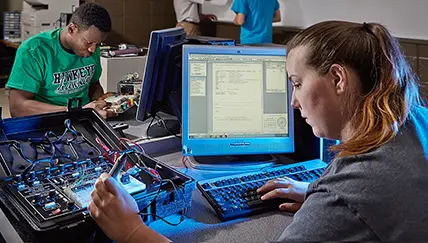
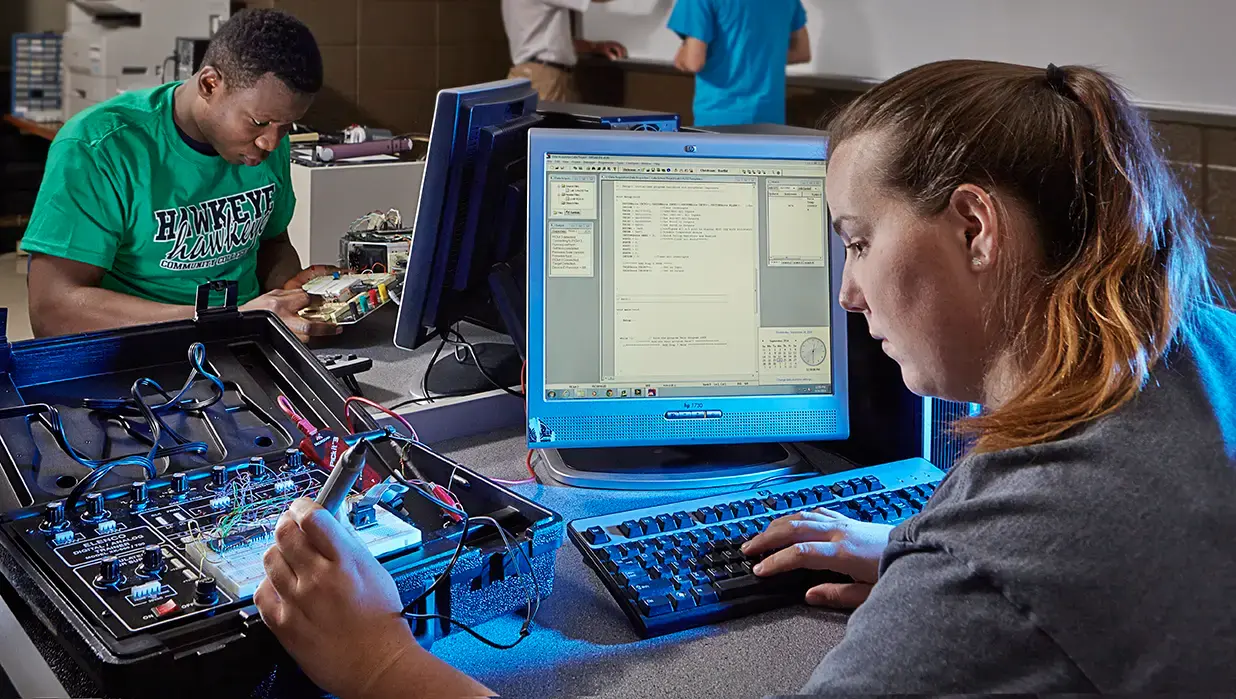
You explore the realm of designing and building electronic devices that drive industries and everyday technology. You gain hands-on skills to operate, test, and repair a variety of electronic systems such as control systems, radios, and computer equipment.

Hawkeye isn't accepting new students into this program beginning fall 2026. If you're interested in this career path, please check out the Industrial Automation Technology program as a great alternative.

Electronics Engineering Technology AAS Degree At a Glance

Award
Associate of Applied Science (AAS) degree
Length of Study
2 years
Course Format
Face-to-Face
Classes Meet
Daytime
Program Start
Fall

See all the Electronics Engineering Technology options at Hawkeye

Your Electronics Career

Graduates generally find employment at manufacturing, technology, and engineering companies. Positions include but are not limited to:

  • Medical electronics technician
  • Electronics communication technician
  • Manufacturing test technician
  • Engineering technician
  • Computer repair technician
  • Computer software technician
  • Business machine service technician
  • Computer network technician
  • Industrial maintenance technician
  • Quality assurance technicians
$2.5T

Global Electronics Market

2.8B

Personal Computers Worldwide

$200B

Global Medical Electronics Market

70%

Of Manufacturers Use Automation

The Hawkeye Difference

Program Overview

You graduate with hands-on experience with:

  • Electrical schematic reading and drafting
  • Electronic communications
  • Electronics manufacturing
  • Electronics maintenance
  • Computer and business machine repair
  • Electronics design and development
  • In-depth applied programming with hardware interfacing
  • Networking

Learn through extensive lab work using microscopes, soldering irons, 3-D printers, and circuit design software. 

Electronic Capstone Project - Demonstrate your knowledge and build your resume with a capstone project. Design, prototype, troubleshoot, and debug an electronics design project and present to your peers and future employers.

Semester 1

  • AC Electricity
  • Basic Mechanical Systems
  • DC Electricity
  • Electronics Math I or
    Calculus I
  • Industrial Safety Mechanical Systems
  • Principles of Engineering or
    PLTW - Principles of Engineering

Semester 2

  • Applied Computer Programming
  • Electronics Devices
  • Electronics Drafting or
    Technical Drawing and CAD
  • Electronics Math II
  • Fundamentals of Oral Communication
  • Operational Amplifiers

Semester 3 — Summer

  • Digital Circuits and Systems or
    PLTW - Digital Electronics
  • Human and Work Relations or
    Introduction to Psychology or
    Introduction to Sociology

Semester 4

  • Applied Physics
  • Communication Circuits I
  • Computer Systems
  • Data Acquisition Systems
  • Electronics Design Project I
  • Visual Basic

Semester 5

  • Communication Circuits II
  • Composition I or
    Written Communication in the Workplace
  • Electronics Design Project II
  • Embedded Processors
  • Industrial Electronics
  • Introduction to Networking

Explore Courses, Details, and Costs

This program qualifies for the Future Ready Iowa Last-Dollar Scholarship and will pay up to 100% of your tuition.

You must apply for, be awarded, and meet the ongoing eligibility requirements for the Last-Dollar Scholarship.

This is a partial list of employers who have hired graduates from this program.

  • Collins Aerospace, Cedar Rapids, IA
  • ConAgra Foods, Inc., Waterloo, IA
  • GARMIN, Olathe, KS
  • John Deere, Waterloo, IA
  • MercyOne, Waterloo, IA
  • Nestlé USA, Waverly, IA
  • Randstad Technologies, Cedar Rapids, IA
  • Schumacher Elevator Company, Denver, IA
  • Simple Mining, Cedar Falls, IA
  • Skyworks Solutions, Inc., Cedar Rapids, IA
  • Target Distribution Center, Cedar Falls, IA

You can get right to work after your program. Or, if you plan to earn an associate degree and go on to earn a bachelor’s degree, consider your transfer options.

There is a documented pathway from this program to UNI's Electrical Engineering Technology and UNI's Industrial Management program. Check out UNI’s transfer guides to learn more.

If you’re interested in transferring, you must work closely with an academic advisor here and at the transfer institution. This is important to ensure courses transfer and you meet program requirements.

Plan your transfer

Program Admission Update

Hawkeye isn't accepting new students into this program beginning fall 2026. If you're interested in this career path, please check out the Industrial Automation Technology program as a great alternative.

Program Contacts

Admissions

Main Campus
Hawkeye Center 134
319-296-4000
Email Admissions

Regular Hours — Spring 2026

Monday – Friday 8 AM – 4:30 PM

Academic Advisor

Natasha Ceaser
Main Campus
Bremer Hall 136C
319-296-4014 ext.1062
Email Natasha Ceaser

Faculty Advisor

Steve Novak
Main Campus
Bremer Hall 143
319-296-2320 ext.1308
Email Steve Novak